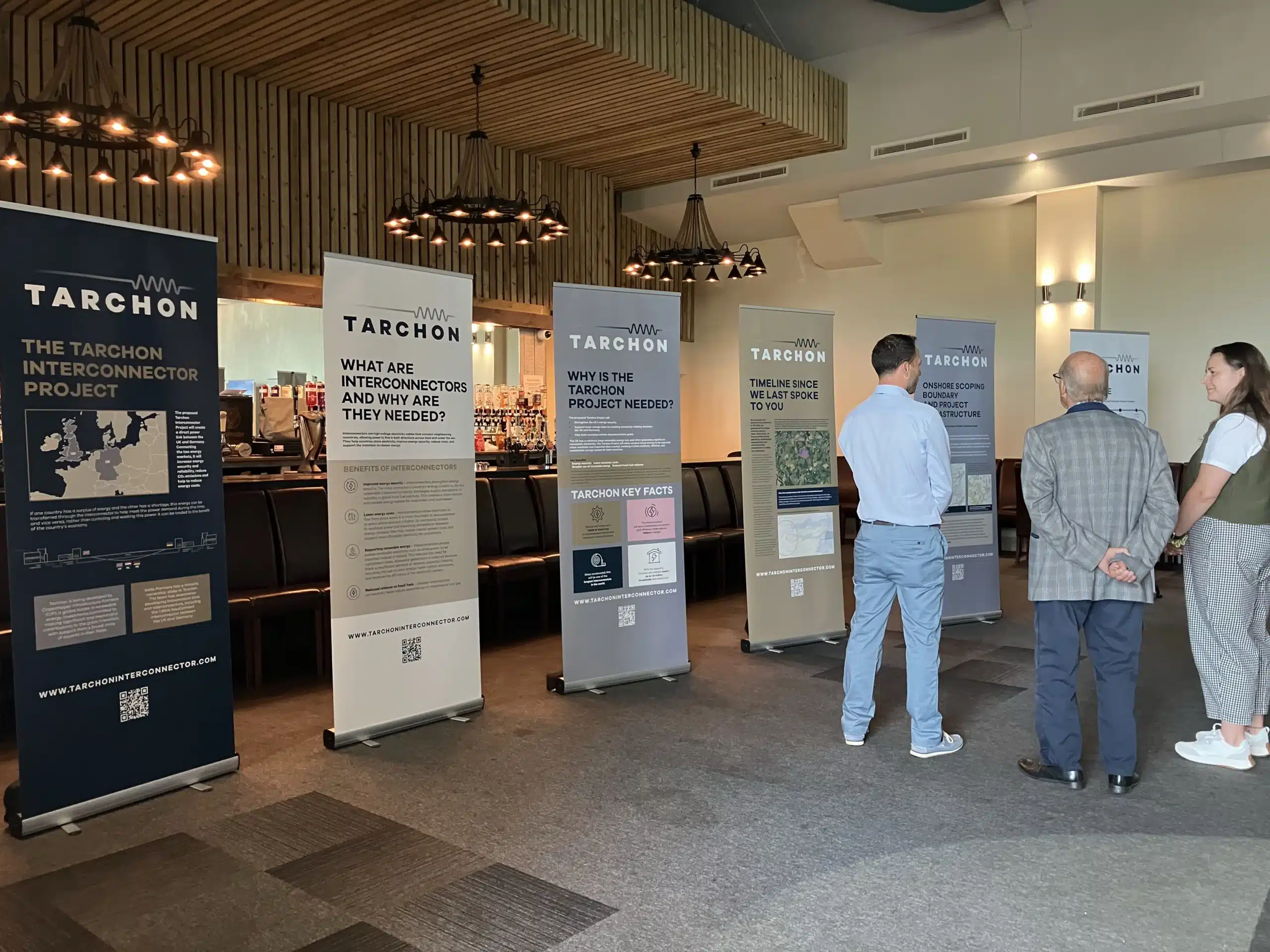
Want to know more about Tarchon?
Timeline and development process
Tarchon is currently in an early phase of project development. The following presents key steps and legal classifications that are important for the further planning and approval process.
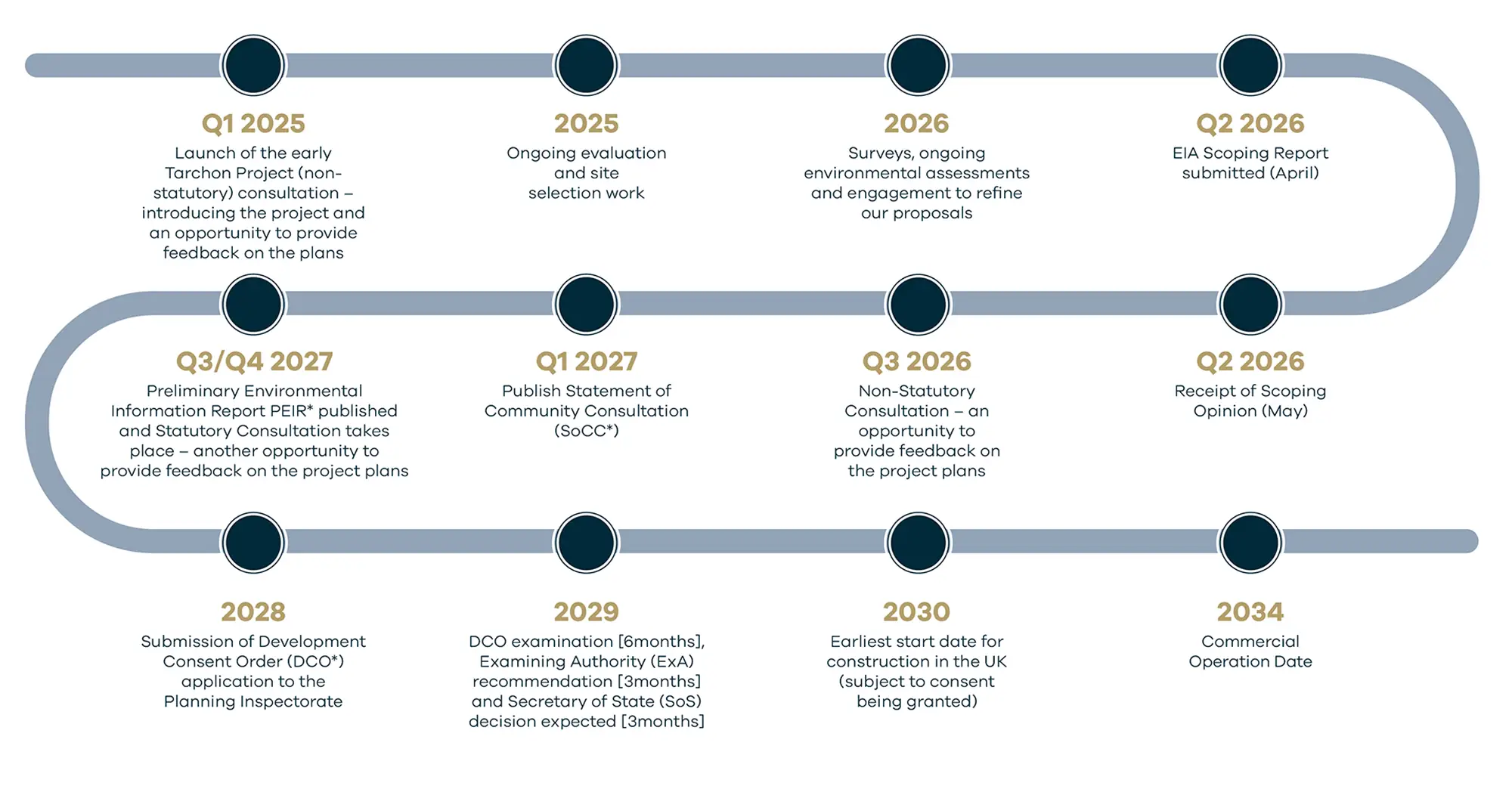
- The SoCC explains how the project will consult local communities before submitting its application.
- The PEIR sets out the likely environmental effects of the project before the final application is submitted.
- A DCO is the planning approval needed for nationally significant infrastructure projects in England and Wales.
Technical implementation
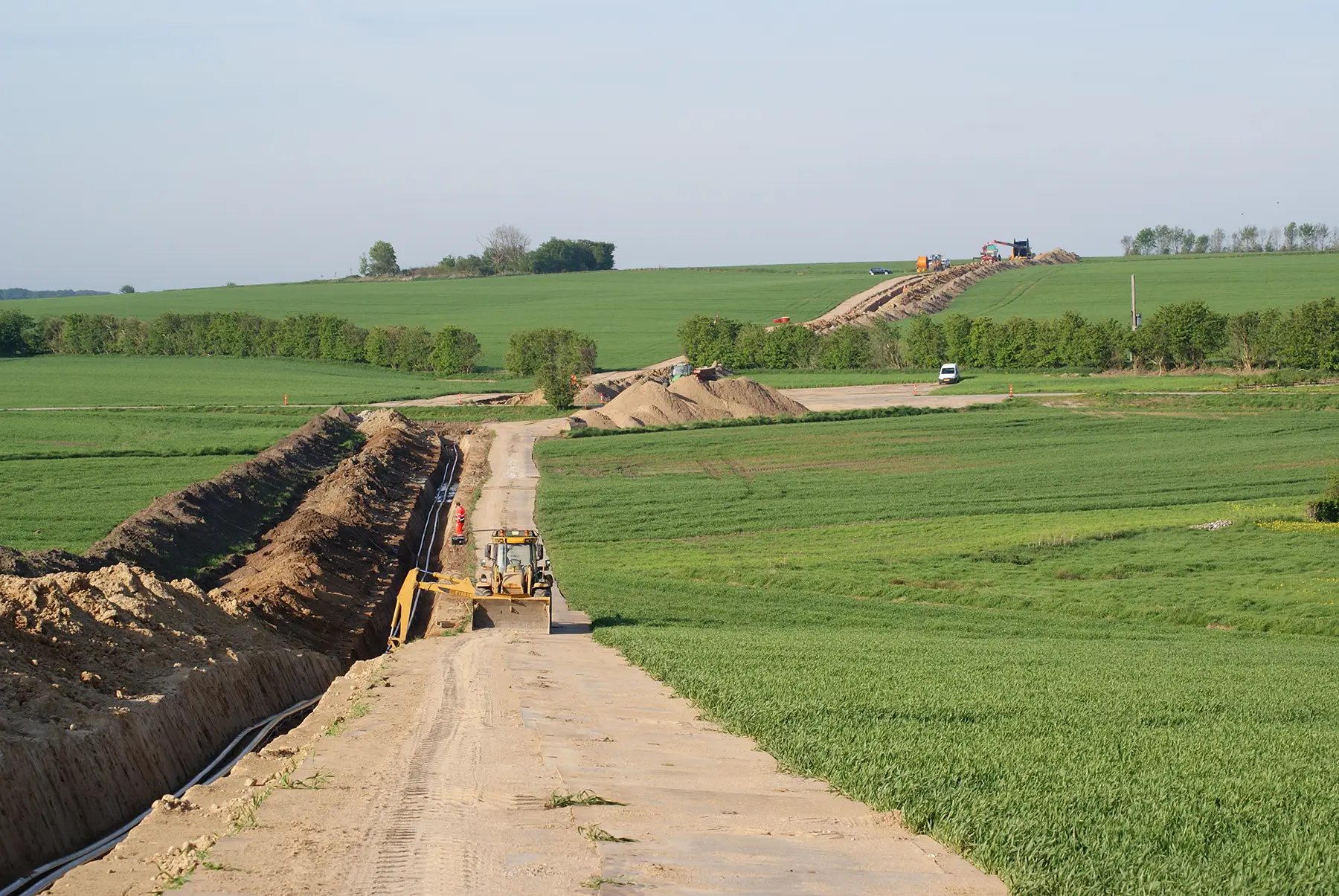
As all cabling will be underground or sub-sea, there will be no pylons or overhead lines. To construct the cable corridor, Tarchon will predominantly use mechanical excavators, with a technique known as Horizontal Directional Drilling (HDD) used to cross sensitive features. This specialised engineering enables the project to work with physical constraints and sensitive features such as rivers, railways and roads.
Tarchon is currently in an early phase of project development. In the designated converter stations, the electricity will be converted depending on the direction of flow and grid requirements from High Voltage Alternating Current (HVAC) to High Voltage Direct Current (HVDC) and vice versa. This enables the bidirectional feed in of electricity into the national grids of both countries. The converter stations consist of several technical buildings and system modules.
The United Kingdom
National Grid has proposed a new East Anglia Connection Node (EACN) 400 kV substation in Tendring. Tarchon was allocated the East Anglia Connection Node (EACN) as the preferred connection point for the project. Consequently, project infrastructure must be sited in close proximity to the EACN grid connection point, requiring a landfall, onshore cable route and onshore converter station within the Tendring district to facilitate the connection. HVAC cabling is proposed to connect the Tarchon converter station to the EACN. HVDC cabling from the converter station to a point where the onshore cabling connects to offshore cabling on the coastline (referred to as the landfall) will be required. The cable will make landfall at a location south of Harwich – the final location is still to be determined within the landfall zone.
The Netherlands
In Dutch territorial waters, Tarchon runs for a length of around 235 km as an underwater HVDC cable. Further along the route, the connection enters the German Exclusive Economic Zone (EEZ) and from there continues towards the German coast.
Germany
Efforts are currently still underway to determine a suitable location at the designated grid connection point Niederlangen. The cable will be installed through Germany’s Exclusive Economic Zone (EEZ), then through the 12-nautical-mile zone and finally beneath the island of Langeoog through the Wadden Sea. The surveys for this are still ongoing.
Overview of the onshore construction
The specific landing points, underground cable corridors, and converter stations are currently being coordinated between the responsible authorities in the UK and Germany. The final locations and route alignments are not yet determined. In order to keep potential impacts as low as possible, the provisionally determined route alignments on land are oriented towards the shortest connections between the designated converter sites and the potential landing points. Technical feasibility, environmental aspects, and spatial compatibility are equally taken into account.
Offshore construction
The route corridor for the underwater HVDC cable is currently being determined. The goal is a technically feasible, environmentally compatible, and spatially coordinated route through the exclusive economic zones and territorial seas of the participating states.
In the UK waters, we are currently appraising potential options by following best practice guidance where it is available, for example from The Crown Estate. We are also in discussion with key stakeholders to confirm the optimal route. Through this work Tarchon is aware of the constraints in this area of the North Sea which include the complexity of shipping operations and fishing activities.
In Dutch territorial waters, the route determination is also carried out in close coordination with key actors. These include, among others, the Ministry of Climate Policy and Green Growth (KGG), the maritime authority Rijkswaterstaat (RWS), as well as the Dutch Enterprise Agency (RVO).
In Germany, a route through the German EEZ was determined for Tarchon in January 2025 in the Area Development Plan (FEP). In the onshore area, the selection of a preferred corridor is currently in preparation. For the territorial sea, a spatially compatible corridor has already been identified, whose confirmation by the responsible spatial planning authority is expected shortly. The detailed routing will then take place following the determination of the preferred corridor.